Saturday, March 5, 2016

Strategies for Growing Fruit on the Oregon Coast

When you live on the coast, one of the things a gardener is told is "you can't grow fruit here."  Which is bunk. Here's what you need to know about growing fruit near the ocean:

1. Pay attention to microclimates.
Most gardeners know about microclimates, little areas of your yard or neighborhood that experience radically different conditions-- like late frosts in a shady corner of the backyard, and intense heat next to a west- or south-facing wall in summer. On the coast our microclimates are intensified, especially where it concerns the effects of wind. 

Your neighbor might be able to grow a certain thing very well, but in your yard the wind comes whipping around the corner of the house and destroys the same plant. So with this in mind, a fruit grower can succeed on the coast; however microclimates must be strictly observed and can be used to advantage.

2. Carefully choose your varieties.
It's tempting to visit the big-box market an hour away from the beach and select a robust fruit tree or shrub. This can be a big mistake. Likewise, that coastal supermarket whose fruiting trees line the sidewalk for a few weeks in springtime should be avoided. I've yet to see a Bing cherry succeed here.

In both cases, you are likely to purchase a plant that is ill-suited to this specialized climate. Average winter temps are warmer than inland, and cooler in summer due to the moderating influence of the sea. Many fruit trees require cold in winter to produce a good fruit set, and long, warm summers to ripen. Choosing varieties developed for production inland may just set you up for frustration. Click here for some of the edible plants that have performed well in my Oregon coast garden.

The solution? Get to know a nursery in your community, particularly if the owner enjoys growing food. They can advise you and obtain the right plants at the right time. Locate your nearest coastal extension office-- for my location, that's in Newport. They have loads of helpful information and may even hold a seasonal plant sale with the right varieties. Finally, seek out neighbors and garden clubs in your community for advice. There's always an expert nearby if you pay attention. Read more about my choices for fruit in these articles.

3. Provide shelter from wind.
The best wind screen for your new fruiting plants is permeable rather than solid. If the wind can be diffused on its way through, the damage on the lee side will be significantly reduced. A solid barrier can actually force the wind to find its way up and over, creating increased eddies and more damage. Knitted shadecloth stretched across a frame (pictured) or existing fence can do the job nicely. I've found 30% shade cloth to be ideal, and knitted holds up in high winds better than woven cloth. Secure it with zip-ties or strong clamps. On the Oregon coast, persistent wind comes out of the north in summer and strong, gusty winds out of the southwest in winter.

A related strategy is to plant a hedge on the north side of your garden to minimize the drying winds of summer. Use coast-adapted hedge plants like these.

4. Make necessary soil amendments.
Due to heavy rainfall, our coastal soils tend to be highly acidic.  Additionally, the sandy makeup in many areas is quick to leach nutrients. Adding lime to boost pH and compost for organic matter are commonly added as topdressing, but testing your soil is a good place to start. If you can't locate a place to send samples, or the wait time is too long, get a high-quality home kit like this one for basic measurements of pH (acidity/alkalinity), nitrogen, phosphorus and potassium. Correcting these major nutrients-- and choosing the right plants-- will go a long way toward growing a successful garden.

Sunday, February 28, 2016

What's Become of My Edible Landscape - Part 1

It's been nearly four years since my last post, and there continues to be interest in this blog. An update on the edibles in my coastal landscape seems timely, given that spring is the time for planting and planning. I'll start with some of the hits in this post, then move on to misses in part 2.

As I wrote before, planting raspberries here (and most places in the Northwest) is a no-brainer. Given their high cost at the market and ease of planting-care-harvest, they are great bang for the buck. My 'Saanich' red raspberries continue to produce mightily from one little row, filling the freezer and our bellies in early summer.

We took a big risk in cutting down the long hedge of arborvitae that provided privacy from our very-close neighbor's house, and replacing it with a row of Asian pears 'Kosui' and 'Chojuro.'  I'm happy to report they are thriving. We created a support structure of cedar posts and stainless wire on which to train our pears in a style known as "pleaching." For a great guide on this and other pruning methods, check out my favorite book on the topic.

The 'Frost' peach that was planted on the south side of our garage, trained similarly, continues producing boxes of peaches every summer. I don't weigh the harvest, instead counting the fruits, and it's usually 300+ on this single tree. The 3-way espaliered apple on my garden fence produces lots of Liberty apples, and a smaller number of Akane and Melrose. Enough for daily lunches and some processing over a few months in the fall.

Blueberries and strawberries continue producing without much trouble, and the Seascape strawberries have yielded lots of starter plants for friends and neighbors. It was great fun when the little girls next door started their very own strawberry bed from the plants I was digging out of my paths. A female Seaberry has been producing small handfuls the last two seasons (a male plant is required too).

For the first time, my Cascade hops made their way into a batch of homebrew last fall... still a ways to go learning that craft but the plants are doing well over the backyard deck. Climbing right along side them in the deck planters are an ever-changing mix of vining tomatoes, scarlet runner beans and flowering annuals. I'll have to write a separate post on the subject of coastal grapes...

Among the less-vigorous, wait-and-see plantings are the 'Negronne' fig tree, 'Red Pearl' lingonberries, cranberries and a hardy kiwi vine 'Issai.' These have all survived and show some promise but have yet to yield any food. A potted pomegranate in my greenhouse surprised me with tiny fruits last season, though they never fully matured. And for the first time I saw tiny cranberries forming on my creeping plants in the garden. Some other creature got to enjoy them but it was fun to see them at last!


Tuesday, March 13, 2012

Winter into Spring

Helleborus x hybridus 'Mardi Gras Black Shades'
Just in time for its namesake festival, a lovely dark perennial bloomed in my front yard.  Helleborus x hybridus 'Mardi Gras Black Shades' is a rare treat in February:  a robust, shade-tolerant perennial showing off its peak bloom when days are just beginning to lengthen.


Like most hellbores, this stunner requires little care in our coastal climate. Its soil and water requirements are modest here (high-organic matter helps hold moisture). 3" blossoms held nodding above shiny broad leaves look almost surreal: silky, dusky purple so deeply colored they verge on black.


A staged planting of spring daffodils provides a backdrop for the hellebore along with a permanent planting of early-blooming primroses, and the whole arrangement happily flanks a mature Japanese maple. Moving into spring and summer, the bulbs fade and are trimmed down, leaving room for a collection of summer flowers including Japanese anemone. 


So just as we were preparing for spring planting in the vegetable garden, after a week of sunny weather encouraged turning the soil and cleaning up over-wintered plants... March reminded us it's still early.


A remarkable 24 hours of winter/spring weather arrived yesterday and didn't let up until this afternoon. First we received high winds, then an amazing downpour of water, followed by an evening of snowfall. Waking up to more than 2 inches of snow on the ground, the finale included lightning and thunder and touch of hail.  


Where last week I had marveled at the arrival of pollinating bees, today we were pruning damaged branches from the Asian pears and hoping the now-blooming peach tree would get some pollinators' attention.


Spring on the Oregon coast has arrived.

Tuesday, August 2, 2011

Coastal Shrub Focus: Hydrangea

As a coastal homeowner, it can be challenging to create an attractive landscape that stands up to the climate and doesn't demand endless hours of maintenance.  Let's face it, people buy homes at the coast so they can enjoy the beach... not spend weekends doing yard work.

After trees, the selection of medium- to large-sized shrubs is critical in designing your landscape.  These large living elements provide the bones for your outdoor space.  With a limited palette of shrubs that can survive and thrive on the coast, it's worth noting one standout that can perform.

Hydrangea macrophylla, the common Mophead Hydrangea, offers many benefits.  This dependable shrub is largely pest- and disease-free, requires infrequent and simple pruning, provides long-lasting bloom with outstanding color, needs little supplemental water, and can serve as a medium-sized foundation shrub.  As a bonus, the flowers can be cut for inside arrangements and even dried for winter.
H. macrophylla 'Nikko Blue'

Hydrangeas are a familiar shrub to inland gardeners, but often present the added burden of regular summer watering.  They tend to get crispy around the edges and the flowers wilt in too much direct sun or high temperatures... which makes the coast an ideal climate for hydrangeas.  Our mild summer temps and misty cool mornings, along with high levels of organic matter in the soil to retain moisture, help to create a perfect setting.

Believe it or not, most coastal hydrangeas receive no supplemental summer watering and perform just fine.  In my front yard, a stunning hydrangea receives late-afternoon reflected heat off a west-facing wall, so I will give it a little water once or twice a week. Even if I forget, the shrub will just droop a little in late afternoon and perk right back up in the evening.

One of the best coastal features of hydrangeas is their ability to withstand our drying winds in summer.  The damaging winter winds don't affect them at all since the leaves have already shed in late fall.  On many coastal landscapes with direct ocean winds, I have seen hydrangeas survive where most other shrubs fail.  Give them just a little shelter for best performance, something to filter the wind like a picket fence or a shore pine.

Picking the right color is one of hydrangea's challenges.  The range of color is basically white-blue-purple-pink.  Occasionally you will find hydrangeas with greenish flowers, and one unusual variety called 'Quickfire' actually changes color during the bloom, from a white to reddish-pink flower.  Oakleaf hydrangeas (Hydrangea quercifolia) generally sport white flowers but offer the additional benefit of oak-shaped leaves with remarkable fall color.  Another popular choice for different texture is the elegant group of Lacecap Hydrangeas, with their delicate blooms.
Lacecap Hydrangea - Flickr.com

Part of the reason color is a challenge with these shrubs is that soil acidity and mineral availability will shift the final hue.  You might for instance purchase what appears to be a pink-flowered hydrangea that in later years moves toward blue or white, a result of our high soil acidity.  A good resource for purchasing and learning about hydrangea color and proper fertilization is Oregon grower Hydrangeas Plus.  Alternatively, buy your shrub from a coastal nursery and ask questions about which ones perform best.

The other main challenge with hydrangeas on the coast is deer protection, yes even in the city.  Lincoln City, for example, has a substantial deer and elk population and hydrangeas are a preferred snack.  My favorite way to protect them is with a deer-repellent spray such as Not Tonight, Deer or Liquid Fence.  Be sure to wear some clothes and gloves you don't mind getting smelly, as the repellent is odor-based.

Other less-common types of hydrangeas include a climbing vine (Hydrangea anomala var. petiolaris) and the taller tree-like species known as PeeGee Hydrangea (Hydrangea paniculata 'Grandiflora'), which grows to 15' tall.

Monday, June 6, 2011

Growing Food, and Community, on the Oregon Coast


Garlic at Taft 7-12

For the past 2 years I have been volunteering to help create a garden and greenhouse program at our local middle/high school, Taft 7-12 in Lincoln City.

The kids' tomato plants
It has been inspiring, interesting, challenging and at times exhausting-- but always rewarding.  My privilege in this role is to work with young people who have a lot on their minds, besides the usual challenges of schoolwork and teen romance.  Many of these students have complicated lives at home, and it can be daunting for them to find the energy to merely learn the standards, much less excel.
Cover crop to enrich the soil


Besides providing them a place to learn about plants, soil, food, science, biology, math, etc... my goal is to give them a safe place for creativity and expand their world.  Give them a reason to get outside, which they do very little.  Give them a place to discover things that are unexpected, like a frog that was hiding by the greenhouse, what fennel tastes like, or the pride of harvesting tomatoes they grew from seed.  Simple joy.
The UCC Congregational Church garden near NW 25th


Our garden is not alone in Lincoln City, providing a place for folks to gather and learn about growing food. Community gardens are powerful in their singular ability to unite people who would otherwise never meet, much less become friends.
Some ambitious peas at the UCC garden

People of all ages, different cultures, some with kids, all belief systems... who come together with only the common bond of growing food for themselves or family.  Community gardens provide the company of others, and in exchange they might impart some long-forgotten tomato wisdom.
Lincoln City Community Garden on NW 21st
Master Gardener demonstration garden- compost bins
 and water collection system.  This garden is located at
Oregon Coast Community College (north).
Brand-new cloche garden at the Food Pantry, built by master gardener Rick Anderson.  Adding fresh produce to the food bank offerings.
Happy artichokes and strawberries at the Taft Community Garden,
 located one block east of Hwy 101 near SW 51st
(at the public parking lot).
 Visit one of Lincoln City's six community gardens to grow food, find inspiration, gardening knowledge, or maybe just enjoy nature in the city.  For an even larger garden community, visit Kitchen Gardeners International and expand your world.

Friday, May 13, 2011

Winning Combinations

This is a short post, or rather boast, about some plant combinations I'm enjoying right now.

Lithodora diffusa is a popular groundcover on the coast, probably for its evergreen leaves and cheerful blue flowers.  Frequently it displays blackened, defoliated branches due to some unknown fungus.  The best cure is to cut it severely back, almost as if you are removing it.  The established roots respond with new fresh growth and profuse flowering as seen here.


Allow it to swarm around the base of taller plants, like this weeping Alberta Spruce (Picea abies var. pendula) and even visually striking edibles like the spiky artichoke above, a great vegetable for mild coastal summers.

Planting into the shadow of the spruce, and at the top (drier) edge of my small rain garden, I looked for a spot of shade-tolerant color year round.  Hence this 'Creme Brulee' Heuchera, also known as Coral Bells.  It's just getting ready to flower.


Providing a rosy, but much darker, backdrop for the Heuchera is one of my favorites for the wetter soils of a rain garden or bog area, Ninebark.  This particular selection was chosen for its burgundy foliage, in this case a horticultural variety of Eastern Ninebark (Physocarpus opulifolius), 'Summer Wine.'  The plant will eventually mature much larger, but I plan to keep it restrained with annual pruning.


Finally, the basin of my rain garden sports a bronzy selection of wet-tolerant sedge, which I think is Carex buchanii.  Sometimes I pick up these plants on a whim of late-summer clearance sales or adopt them from the nursery's cull pile, hence I'm not always sure of the exact species or variety.

What combinations are emerging in your spring garden that delight the eye?

Monday, May 2, 2011

Candling Pines

Some gardening activities are tied to the calendar.  When it's February, I prune roses.  In March, time to cut back the ferns.  And in April (though our cool spring has delayed the season), I am candling pines.

For those who may have not heard this term, "candling" refers to the very prominent terminal buds that emerge on pine trees and shrubs in spring, as they push out their new growth.  The upright, long slender buds appear like candles on a candelabra.  It is during this period that a gardener can take advantage of the soft new growth to restrict the size and create deliberate shape on plants of this genus.

On the coast, by far the most common Pinus species is the Shore Pine, Pinus contorta var. contorta.  It's worth noting for future gardening trivia games that it is the same species known in inland mountain regions as the Lodgepole Pine (Pinus contorta var. latifolia).  Which goes to show you what climate will do to cause adaptation in a plant's growth habit.  If you're not sure what pine you have, a key identifying characteristic on Shore Pines is the backward-facing cones on the branches, pointing toward the trunk.  But I digress.

Another common Pinus species on the coast is the Mugo Pine, frequently planted for its small stature, which varies from a low groundcover size to small shrub.  Not all Mugo Pines are alike: many folks select one hoping it will stay low to the ground like the one pictured here.  If this is your goal, choose a cultivar like 'Oregon Jade' which has very short internodal spacing (the length of stem between branches).

For both of these pines, and many others, candling is a technique which will allow a gardener to accomplish a couple important goals:  determine appearance and restrict size.
Mugo Pine, removing the candles

Essentially what you are doing is breaking off the terminal bud before it has expanded into a longer branch with smaller branches and needles.  The closer you break it off to the base, the shorter your eventual branch will be.  The goal isn't to remove every last bit of the bud, as you want the plant to experience a little growth each year for its health.

If you are candling for appearance, the goal might be to create a smooth, even look to the shrub, as if you had used the hedge trimmer.  Some readers might wonder, why don't we just use a hedge trimmer?  What happens with this tool is that instead of breaking off the terminal bud and allowing it to naturally finish expanding, you are cutting through everything including older growth, needles, etc.  The result in a month or two is a "burned" look on the top, where all those cut ends turn brown.
Shore pines at Wecoma Park in Lincoln City

Candling for a smooth look (you might have seen the "cloud"-style pruning favored in Japanese gardening) is simple.  Just start breaking off the soft growth on the uppermost part of your shrub, at the top of the selected plane or curve.  Then work your way along, breaking off the buds to match this general curve or plane as it suits your eye.  In a month or so the pine will have grown out evenly-- though there are always a few buds that stubbornly come out late, just remove them when you see them.

One of the nicest features of Shore Pines is the long internodal spacing between branches, which lends itself to "cloud" pruning.  Select a few widely spaced branches and remove those that are in between.  Then begin your annual regimen of candling to create the "cloud" effect.  As the tree grows too tall to reach, it will still maintain a general look of the pruning style, but if you are really fussy you can get up there on an orchard ladder and remove buds.
Cloud pruning, done less formally

If you have a lot of candling to do, one time saver is to use a pocket pruning saw blade to knock the buds off.  Once there is an established plane or curve, the buds will be easy to knock off with a swift lateral swipe of your saw blade.  You aren't trying to cut anything... but the teeth on your blade will catch the buds and break them off in large numbers.  To make cleanup easy, lay a tarp down under the tree before starting.

A final tip: use an old pair of gloves for this task, or designate some for dirty jobs.  The candles usually produce pitch that is very difficult to remove.

Saturday, April 16, 2011

The Venerable Vine Maple

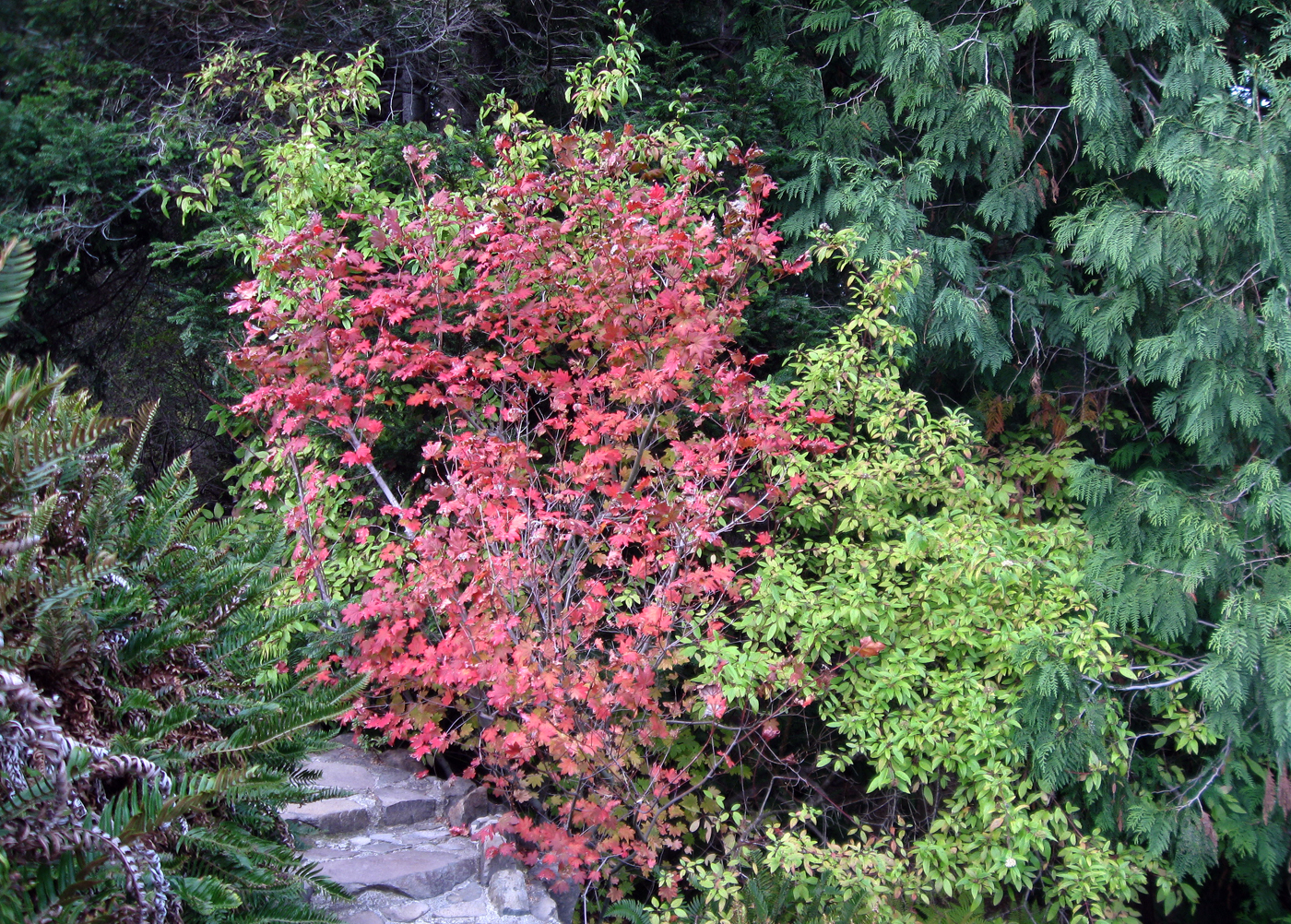
Vine maple fall color at Tilden Botanic Garden in Berkeley CA,
photo courtesy of drystonegarden.com
Fairly often I am asked by coastal garden clients whether they can plant a maple tree.

Usually what they mean is a Japanese maple (Acer palmatum), like a Coral Bark Maple or a Laceleaf Maple.  Sometimes they are interested in an upright, larger species like the taller Japanese varieties, or even a Red Maple (Acer rubrum).  Most folks don't have room in the yard to even consider our Northwest native Bigleaf Maple (Acer macrophyllum).

More often than not, after determining their specific goal-- color? shade? accent tree?-- my answer is to suggest the coastal native Vine Maple, Acer circinatum.

Other maples will grow here, given sufficient moisture, good drainage and shelter from wind.  And I do mean shelter from wind.  A coastal gardener might plant a perfectly good Willamette-Valley-grown nursery tree, like an upright Japanese maple, only to see it defoliate on one side, lean away from prevailing winds, leaf tips turning brown and crispy in mid-summer and finally an early drop of sad brown leaves without any fall glory.

One of the primary features sought after when choosing a maple tree is that amazing display of fall color.  Depending on the species, it may range from a solid golden showing to a blazing range of sunset hues.  So it's pretty disappointing when your maple goes from summer green to dead brown all in one shot.  Partly this is due to the climate, since great fall color is a combination of sunny weather and cold night temps.

This is where Vine Maples really shine.  Since they are adapted to our mild climate, it takes little of the cold fall air to bring on the color.  Even within the city limits of Lincoln City, several blocks from the ocean, the Vine Maple is capable of a display including reds and yellows, and lasting several weeks.

Entering winter we enjoy another fine feature of this tree, the lovely mottled grey-and-white smooth bark.  (Young trees have greener bark that improves with age).  The bark is best displayed by using an upright pruning style, with the usually multi-trunked Vine Maple cleared of lower branches and excess root suckers.  Allow the upper canopy to spread with just occasional thinning as needed for light and wind passage.


Uses for this small tree include placement in tight or shady areas close to a structure or walkway.  Because the canopy is fairly narrow, it can be easily pruned to arch gracefully over a path or the eaves of your house, without causing damage.  Since the leaves are small (similar in size to Japanese maples) they make for easy cleanup in the fall and are not likely to cause clogged gutters like those of Bigleaf Maple.  Underplanting a Vine Maple with spring bulbs or low-growing native plants including perennials is quite charming, and provides an opportunity to explore a shade-loving palette.  Vine Maples are especially pleasing if they can be placed where afternoon sun can backlight the glowing leaves, and they are right at home beside a stream or "dry creekbed" landscape feature.

Vine maple is easily pruned in tight location

Caring for a Vine Maple is simple on the central coast.  They should be given some shelter from direct ocean winds, but can be used on the lee side of many homes near the oceanfront.  Like most natives, they don't require fertilization if they are planted in average coastal topsoil, which tends to be high in organic matter and fairly acidic; if your soil is poor, dig a large hole and add compost to mix with the surrounding soil.

Provide your Vine Maple with a little supplemental water (once a week is plenty) in the dry months of late summer, especially when it's getting established the first couple years.  Prune as desired for shape, but please don't top this tree-- it will spoil the structure.  Sit back and enjoy your fine native tree.

Resources for Vine Maples:  On the central coast, Blake's Coastal Nursery and Landscape in Gleneden Beach (Loop Rd., exit just south of Salishan, continue into Gleneden and Blake's is on the left hand side).

In the Willamette Valley, my favorite for natives is Wallace Hansen's nursery in Salem, which is unfortunately closed at this time but the website offers loads of information on native plants, for free.  Take a look.  Most nurseries in the Valley that carry trees of any kind will offer Acer circinatum.

Sunday, April 10, 2011

Leaks and Opportunities

Yesterday we had a welcome preview of summer weather: sunny and mildly warm, with light wind. Coastal summers are typically dry from mid-June to mid-October, just the opposite of our sodden winters.

This year, after four years on our property, my plan is to finally design and build at least the start of a gravity-fed, rainwater-collected drip system for my vegetable garden. I have been planning it (in my mind) since we bought the place, and now it's time to get my hands wet.
The house in background, provides opportunity for gravity feed to garden

The contour of our property is ideally suited for this project. Our house sits above the garden, which is literally "sunken" about 6 feet below the grade of our foundation. Closer to the garden grade, but slightly higher and directly adjacent, is the garage and attached lean-to greenhouse. And our chicken coop wraps neatly around a small building used for storage and processing produce in season, we call the "fruit room."

The soil in the most of my front and side-yard landscape retains moisture (in our relatively cool summers) so that a weekly watering is enough. And because these areas are largely planted with shrubs and well mulched, I prefer to hand-water the shrub beds so I can have a look at everything.

Another good reason on the coast for overhead watering, at least occasionally: salt fog. A local nurseryman reminded me of this fact, in late summer we get little rain and regular morning fog which is laden with salt from the ocean. This salty mist deposits a crust on everything (check your windshield in August) including plants.  So occasional overhead watering is a good thing on the coast, to give the plants a rinse.

The needs in my vegetable garden are different; anyone growing food knows the water requirements are generally greater than landscaped shrub beds. In the past couple years I have experimented with scheduling and found watering every third day to be just right. I plant closely in raised beds and add lots of organic matter to the soil, and the "sunken" location of the garden helps to reduce moisture loss. I want to avoid wasting water on pathways, and reduce the constant threat of fungal disease from too much moisture.  So the obvious answer is drip irrigation, and lucky me, I came across a deal on emitter tubing last fall.

Coop wraps around 'fruit room'
My irrigation plan as of this writing:

Chicken coop: supply water to the birds by installing a filtered diverter from the fruit room gutters into their 5-gallon bucket waterer, already installed, which includes "nipples" to reduce water waste and keeps it clean.

Greenhouse: install a 2-barrel collector just outside the door, collecting water from the greenhouse roof. This will allow me to shut off the outside water supply to the greenhouse sink that causes freeze-anxiety in winter, due to the fact the building is not heated. The barrel storage will provide plenty for filling watering cans to maintain plants in the greenhouse and outside cold frame nearby.

House to garden:  install a large water storage for gathering water off the house, and gravity-feed to garden drip system. Garden beds will be arranged with in-line drip emitter tubing, supplied by a poly main line that can be connected to the filtered tank. When water supplies are low, the drip system can be alternately connected to the city water supply from our existing garden hose-bib.

The first task is to repair our outside water line that I had to cut last fall. As usual, we had a spike in water use around late summer/early fall, due to little rainfall and high garden production. We got the usual notice from the city, to point out our higher-than-normal usage. We didn't actually worry until November, when we noticed the previous bill had not declined... but actually increased. Uh-oh.

Searching for the leak was no easy task, and after checking everything in the house and digging up every outside connection (including the water meter), we guessed the leak was underground and cut the line between house and garden.  Wouldn't you know, that wasn't it...grrr.  Finally we located a mystery valve under the house (!) leading to another outside line, shut it off and voila!  The meter stopped turning.

So now that drier weather has returned... we get to do some repair work.

Other resources: 
Peaceful Valley Farm Supply's short video on drip irrigation (beginners).
Supplier of drip irrigation, including several starter kits and parts.

Thursday, March 31, 2011

A Walk on the Wild Side


Wet and cool weather for the whole of March has made it tough to find opportunities in the garden-- much less, to feel like spring has finally arrived.

Alas, the adapted coastal native plants may be our surest signs: a recent wetlands walk had me surrounded by these cheery Northwest harbingers: Hooker's Willow, Skunk Cabbage, and Indian Plum.

In Lincoln City we are fortunate to have several parcels of undeveloped land set aside for the community as "open space."  In addition we are lucky to have an Oregon State Park on the shore of Devils Lake right in the middle of town, and this park features a public wetlands trail.  The route is short but pleasant, changing from muddy track to raised low-impact boardwalk made from recycled lumber.  The construction is a special pier-type system which requires fewer intrusions into the ecology and allows for water passage beneath.

Walk this trail in late March beginning at the park entrance gate-- a small marked footpath to the right-- and the sight of Skunk Cabbage, Lysichiton americanum, will stop you in your tracks.  The glowing yellow bracts pushing from the mucky creekbed seem to light your way along the path, recalling the alternate common name Swamp Lantern.  I find them every bit as spring-cheerful as daffodils, and somewhat miraculous in their adaptation to the heavy sodden soils of our coastal wetlands.  Their notorious odor was not even noticeable on this day.

Strolling further south, the larger trees of the park give way to a sunny (if there were ever sun shining) opening featuring wetland grasses, forbs and shrubs.  It's here that both Hooker's Willow and Indian Plum take center stage.  Indian Plum, Oemleria cerasiformis, is one of my favorite natives both for its charming delicate blossoms that hang in white clusters and for its brilliant green spring foliage.

Oemleria cerasiformis, Indian Plum
The little flourishes of upright new leaves decorate its branches, startling against a backdrop of dark and dreary forest edge.  They are most noticeable along Northwest highways, such as driving through the Coast Range, before all the other deciduous plants leaf out and retire the plum to its background role.  Although this little native shrub produces actual plums, valuable as wildlife food, rarely is the plant noticed at that time of year. It's in early spring when Indian Plum steals the show.

A spring bouquet would not be complete without a few showy branches of Pussy Willow... but the coastal native Hooker's Willow, Salix hookeriana, is the one on display in our wetland.  An amazingly tough and adaptable shrub, it will grow into the sandy bluffs where drainages flow toward the ocean, as it does in the north end of town on a foot path from NW 50th.  Showing its preferences for wet soils, the lovely shrub proliferates on the Devils Lake wetlands trail, those classic fuzzy buds bursting forth on long arching branches that reach overhead.

One method I've been meaning to try is to use cuttings of our native willow to create a rooting-tea: plants in this genus all produce a natural rooting chemical that can be extracted by soaking in water, then used as a drench for propagating other plants.  I'm a sucker for free plant products.


Finally, I had to make note of the Red Alder trees just breaking dormancy.  Delightful year-round, alders in this season dangle their ornamental cones from last year along with both male and female catkins as they prepare for pollination.  The unique stalked, red buds become more deeply colored just before leafing out, lending an overall impression of rosy glow to the dense branches.  Alders are somewhat shorter (probably limited by the challenging soil conditions) in the wetland, but lend a nice overstory component to the collection of low vegetation found on this charming wetland walk.

To access this trail, approach from the Devils' Lake Campground entrance gate on NE 6th, just behind the Lincoln City Cultural Center.  If you are driving (and not staying at the campground) you can alternatively park in a public lot at the other end of the trail, at NE 1st Street.  Turn east from Hwy 101 at the Comfort Inn (on the north side of the D River), and continue on the gravel driveway to its end for the parking lot.


My favorite reference for native NW plants:

Thursday, March 24, 2011

Experimental Fruit 101

Last weekend I visited (for the first time) our local Fruit Scion Exchange, held by the Home Orchard Society in Canby at the Clackamas County Fairgrounds this year.

As an avid fruit grower with just a middling knowledge on the subject, it was a thrilling sight!  Hundreds of people cramming excitedly into the building for the chance to get their hands on some rare variety of fruiting plant.  Isn't it great that food gardening has become so popular?

For the novice, this event can be overwhelming and confusing with so much to choose from and little explanation of procedure. The volunteers work really hard to make it come together, so it's not meant as a criticism... but the noise level inside made it nearly impossible to ask questions. Would have liked to watch the expert grafters at work but those lines were forever long, as was the rootstock table.  I took some grafting in horticulture school but never did enough to get really good at it-- yet.

Female Seaberry leafing out
Basically the way a "scion exchange" works is that you pay an entry fee, which entitles you to as many fruit scions as you want, for free.  Scion wood is the part on your tree/plant that produces the edible variety.  That part is grafted onto a rootstock, which determines overall height and vigor of the tree, among other characteristics.  Your free scions must now be grafted onto something... so you can either stand in the long line to buy rootstock ($5 or so) and do it yourself, or pay the experts to graft it for you (another table).  Now you have a complete fruit tree to take home and baby for a year so the graft can knit together.

The other option is to take your scions home and graft them onto existing trees in your landscape.  Perhaps you have an old vigorous cherry tree that only produces the tiny sour cherries and you want some sweet ones.  Or you have an apple tree with a single variety and you'd like several on that tree.  Some folks even graft onto related plants, like a named apple variety onto wild crabapple.

Since I was unprepared as to variety information, I picked up a few scions knowing nothing about them.  Some had been recommended to me as a coastal gardener, from folks on the HOS forum.  Everything fruit-wise on the coast is an experiment, so I'm willing to give things a shot. Here's what I brought home:

Apples - Honeycrisp (a favorite), Airlie Red Flesh (also known as Hidden Rose), King Luscious
Pear - Orcas (a Puget Sound variety), Swiss Bergamotte
Asian Pear - 20th Century
Grape - Swensen's Red

Other fruits I'm growing in my home landscape in Lincoln City OR are experimental, those already bearing fruit successfully are marked in bold.  Others are quite young so it's too soon to tell, stay tuned.


Lingonberry 'Red Pearl' (OGW)
Espalier apple, 3 way: Liberty, Akane, Melrose (BL)
Espalier pear, 3 way: Bartlett, Rescue, Anjou (BL)
'Rescue' pear blossoms
spring peach blooms
Peach 'Frost', fan-trained on south wall  (BL)
Thornless blackberry 'Black Satin'
Cascade Berry, gift from our clients' Seattle home
Purple-leaf fruiting plum, unknown rooted variety, heirloom from client
Olives 'Arbequina' and 'Leccino' (OGW)
Seaberry (male & female) 'Garden's Gift' (OGW)
Honeyberry 'Blue Pacific' and 'Blue Velvet' (OGW)
Strawberry 'Seascape' (BL)
Raspberry 'Saanich' (RT)
Asian pears 'Kosui' and 'Chojuro', training into pleached form as screen (BL)
Alpine strawberry 'Mignonette'
Hops- 'Golden' (BL), 'Nugget' and 'Cascade'
Grapes - Sauvignon Blanc, 'Price', 'Crimson Bunch', 'Ortega'  (RT)
Black currant 'Crandall' (RT)
Evergreen huckleberry, native
Blueberry- 3 bushes, 'Duke' and 'Blue Crop' (BL)
Cranberry 'Stevens' - creeping groundcover type (RT)
Fig 'Negronne' - potted in greenhouse
Hardy kiwi 'Issai' (OGW)
Pomegranate (BL) - potted in greenhouse, outside summer
Citrus, unknown orange variety - potted in greenhouse, outside summer
Nanking Cherry (bush-type) - heirloom from my grandfather's garden

Non-fruiting food plants, perennial:
Rhubarb, 'Victoria' (BL)
Asparagus - unknown (BL), this will be the 3rd year
Artichokes - 'Green Globe' I think (BL)
Cinnamon vine (tuberous) 'Dr. Yao' (OGW)
Ginger -potted, from organic grocery
Wintergreen - leafy groundcover (OGW)
Tea shrub 'Sochi' (OGW) - man, do the deer love this one!
Saffron crocus (OGW)
Daylilies (for edible flowers) - several

Deer protection on tea
Jerusalem sage - not an herb, but leaves edible - (BL)

Legend: Plants purchased mail-order from Raintree Nursery (RT), One Green World (OGW) or in-person from Blake's Coastal Nursery in Gleneden Beach (BL).  Some were obtained from other gardeners.  Please note whether they can ship to your state before ordering fruit.


What kind of fruit are you growing in your landscape or garden?