Showing posts with label native trees. Show all posts

Saturday, April 16, 2011

The Venerable Vine Maple

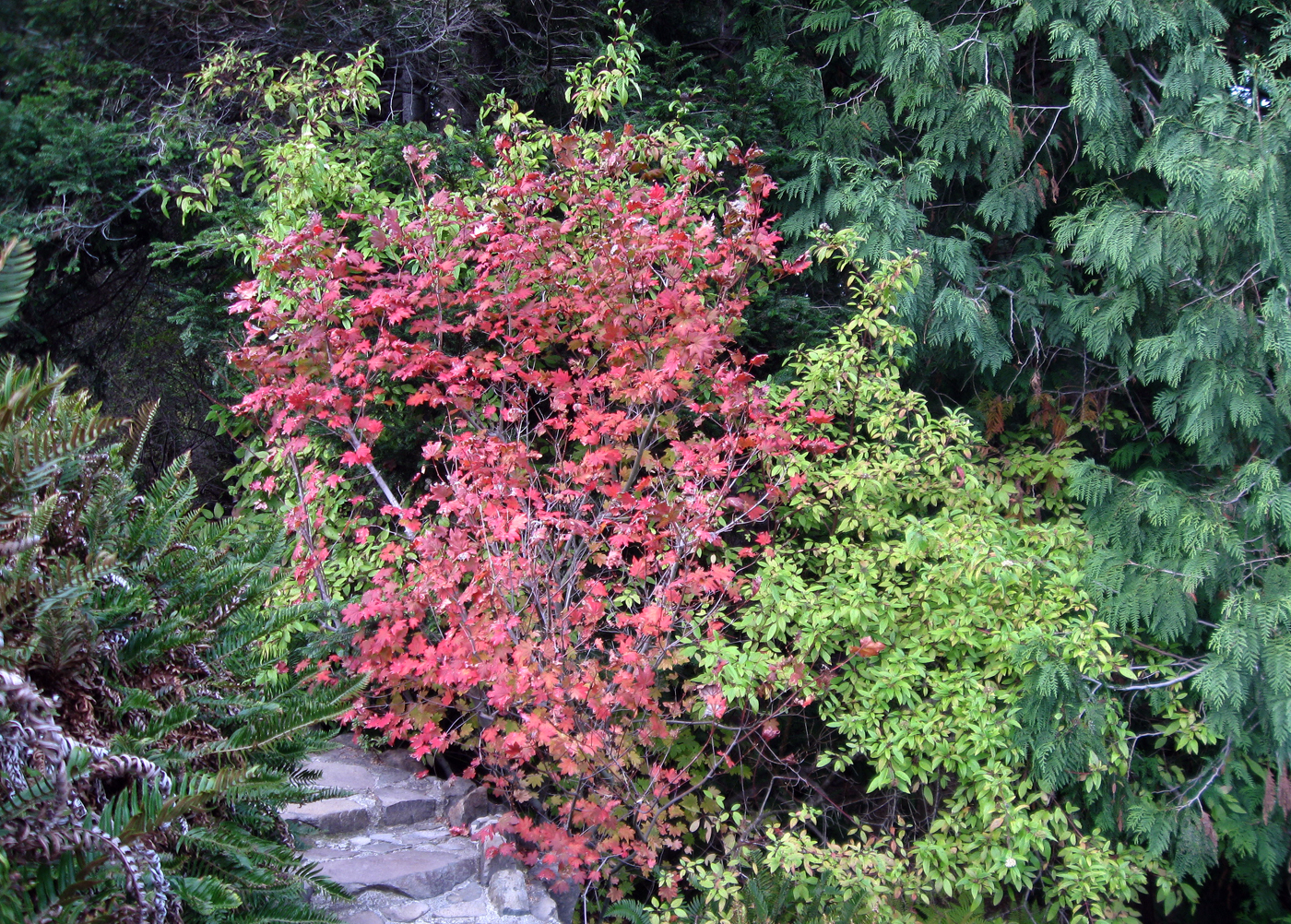
Vine maple fall color at Tilden Botanic Garden in Berkeley CA,
photo courtesy of drystonegarden.com
Fairly often I am asked by coastal garden clients whether they can plant a maple tree.

Usually what they mean is a Japanese maple (Acer palmatum), like a Coral Bark Maple or a Laceleaf Maple.  Sometimes they are interested in an upright, larger species like the taller Japanese varieties, or even a Red Maple (Acer rubrum).  Most folks don't have room in the yard to even consider our Northwest native Bigleaf Maple (Acer macrophyllum).

More often than not, after determining their specific goal-- color? shade? accent tree?-- my answer is to suggest the coastal native Vine Maple, Acer circinatum.

Other maples will grow here, given sufficient moisture, good drainage and shelter from wind.  And I do mean shelter from wind.  A coastal gardener might plant a perfectly good Willamette-Valley-grown nursery tree, like an upright Japanese maple, only to see it defoliate on one side, lean away from prevailing winds, leaf tips turning brown and crispy in mid-summer and finally an early drop of sad brown leaves without any fall glory.

One of the primary features sought after when choosing a maple tree is that amazing display of fall color.  Depending on the species, it may range from a solid golden showing to a blazing range of sunset hues.  So it's pretty disappointing when your maple goes from summer green to dead brown all in one shot.  Partly this is due to the climate, since great fall color is a combination of sunny weather and cold night temps.

This is where Vine Maples really shine.  Since they are adapted to our mild climate, it takes little of the cold fall air to bring on the color.  Even within the city limits of Lincoln City, several blocks from the ocean, the Vine Maple is capable of a display including reds and yellows, and lasting several weeks.

Entering winter we enjoy another fine feature of this tree, the lovely mottled grey-and-white smooth bark.  (Young trees have greener bark that improves with age).  The bark is best displayed by using an upright pruning style, with the usually multi-trunked Vine Maple cleared of lower branches and excess root suckers.  Allow the upper canopy to spread with just occasional thinning as needed for light and wind passage.


Uses for this small tree include placement in tight or shady areas close to a structure or walkway.  Because the canopy is fairly narrow, it can be easily pruned to arch gracefully over a path or the eaves of your house, without causing damage.  Since the leaves are small (similar in size to Japanese maples) they make for easy cleanup in the fall and are not likely to cause clogged gutters like those of Bigleaf Maple.  Underplanting a Vine Maple with spring bulbs or low-growing native plants including perennials is quite charming, and provides an opportunity to explore a shade-loving palette.  Vine Maples are especially pleasing if they can be placed where afternoon sun can backlight the glowing leaves, and they are right at home beside a stream or "dry creekbed" landscape feature.

Vine maple is easily pruned in tight location

Caring for a Vine Maple is simple on the central coast.  They should be given some shelter from direct ocean winds, but can be used on the lee side of many homes near the oceanfront.  Like most natives, they don't require fertilization if they are planted in average coastal topsoil, which tends to be high in organic matter and fairly acidic; if your soil is poor, dig a large hole and add compost to mix with the surrounding soil.

Provide your Vine Maple with a little supplemental water (once a week is plenty) in the dry months of late summer, especially when it's getting established the first couple years.  Prune as desired for shape, but please don't top this tree-- it will spoil the structure.  Sit back and enjoy your fine native tree.

Resources for Vine Maples:  On the central coast, Blake's Coastal Nursery and Landscape in Gleneden Beach (Loop Rd., exit just south of Salishan, continue into Gleneden and Blake's is on the left hand side).

In the Willamette Valley, my favorite for natives is Wallace Hansen's nursery in Salem, which is unfortunately closed at this time but the website offers loads of information on native plants, for free.  Take a look.  Most nurseries in the Valley that carry trees of any kind will offer Acer circinatum.

Thursday, March 31, 2011

A Walk on the Wild Side


Wet and cool weather for the whole of March has made it tough to find opportunities in the garden-- much less, to feel like spring has finally arrived.

Alas, the adapted coastal native plants may be our surest signs: a recent wetlands walk had me surrounded by these cheery Northwest harbingers: Hooker's Willow, Skunk Cabbage, and Indian Plum.

In Lincoln City we are fortunate to have several parcels of undeveloped land set aside for the community as "open space."  In addition we are lucky to have an Oregon State Park on the shore of Devils Lake right in the middle of town, and this park features a public wetlands trail.  The route is short but pleasant, changing from muddy track to raised low-impact boardwalk made from recycled lumber.  The construction is a special pier-type system which requires fewer intrusions into the ecology and allows for water passage beneath.

Walk this trail in late March beginning at the park entrance gate-- a small marked footpath to the right-- and the sight of Skunk Cabbage, Lysichiton americanum, will stop you in your tracks.  The glowing yellow bracts pushing from the mucky creekbed seem to light your way along the path, recalling the alternate common name Swamp Lantern.  I find them every bit as spring-cheerful as daffodils, and somewhat miraculous in their adaptation to the heavy sodden soils of our coastal wetlands.  Their notorious odor was not even noticeable on this day.

Strolling further south, the larger trees of the park give way to a sunny (if there were ever sun shining) opening featuring wetland grasses, forbs and shrubs.  It's here that both Hooker's Willow and Indian Plum take center stage.  Indian Plum, Oemleria cerasiformis, is one of my favorite natives both for its charming delicate blossoms that hang in white clusters and for its brilliant green spring foliage.

Oemleria cerasiformis, Indian Plum
The little flourishes of upright new leaves decorate its branches, startling against a backdrop of dark and dreary forest edge.  They are most noticeable along Northwest highways, such as driving through the Coast Range, before all the other deciduous plants leaf out and retire the plum to its background role.  Although this little native shrub produces actual plums, valuable as wildlife food, rarely is the plant noticed at that time of year. It's in early spring when Indian Plum steals the show.

A spring bouquet would not be complete without a few showy branches of Pussy Willow... but the coastal native Hooker's Willow, Salix hookeriana, is the one on display in our wetland.  An amazingly tough and adaptable shrub, it will grow into the sandy bluffs where drainages flow toward the ocean, as it does in the north end of town on a foot path from NW 50th.  Showing its preferences for wet soils, the lovely shrub proliferates on the Devils Lake wetlands trail, those classic fuzzy buds bursting forth on long arching branches that reach overhead.

One method I've been meaning to try is to use cuttings of our native willow to create a rooting-tea: plants in this genus all produce a natural rooting chemical that can be extracted by soaking in water, then used as a drench for propagating other plants.  I'm a sucker for free plant products.


Finally, I had to make note of the Red Alder trees just breaking dormancy.  Delightful year-round, alders in this season dangle their ornamental cones from last year along with both male and female catkins as they prepare for pollination.  The unique stalked, red buds become more deeply colored just before leafing out, lending an overall impression of rosy glow to the dense branches.  Alders are somewhat shorter (probably limited by the challenging soil conditions) in the wetland, but lend a nice overstory component to the collection of low vegetation found on this charming wetland walk.

To access this trail, approach from the Devils' Lake Campground entrance gate on NE 6th, just behind the Lincoln City Cultural Center.  If you are driving (and not staying at the campground) you can alternatively park in a public lot at the other end of the trail, at NE 1st Street.  Turn east from Hwy 101 at the Comfort Inn (on the north side of the D River), and continue on the gravel driveway to its end for the parking lot.


My favorite reference for native NW plants:

Monday, February 21, 2011

Top 10 Mistakes by Coastal Gardeners

I love plants-- and truly enjoy working with my clients to fully appreciate the plants in their gardens.

Frequently, I am asked by concerned homeowners the same questions about their landscapes.  So I figured it might be useful to make a list of what this professional landscape gardener would advise clients NOT to do in their coastal gardens, and avoid common pitfalls.

10.  Planting shrubs or trees because they are cheap or familiar, without any research on coastal conditions.  A common mistake: new coastal residents may think, well it's still Oregon, still the same zone, and I like this or that plant.  Why not grow it here?  The Willamette Valley, where most new residents come from, provides ideal growing conditions for a vast array of nursery plants-- the coast has a much smaller palette from which to draw.  Wind, salt, sandy soil, heavy winter rainfall and a much milder growing season (insufficient heat for many plants) are among the reasons.  Please visit with a quality coastal nursery and spend a little time talking with the knowledgeable staff, before you design and plant your garden.

9.  Failing to provide for torrential rain (drainage) in winter.  This might seem obvious but it really gets overlooked when people design the new house and yard, or purchase an existing one.  Really take the time to figure out where the water from your downspouts will end up, and where it comes rushing down your street, and talk to neighbors about any problems with storm drains, etc.  Many times when we see a tree or shrub mysteriously die in someone's landscape, we dig it up and lo, the hole is filled with water.  Drainage!

8.  Failing to provide wind shelter (from the north and west) in summer.  Coastal homeowners often realize there are strong winds in winter with the dramatic storms, but fail to account for the persistent dry winds that occur in summer.  These are mostly from the north, more often than directly from the ocean (west), and usually the cause of brown leaves and dieback on the north side of plants.  Often the solution is a simple windscreen (made from shadecloth) for the first couple years until plants are established. Related to this problem is inadequate summer water.  If you want to grow a good-looking lawn, it will unfortunately require lots of summer water.  Shrubs are less needy but need water if they are exposed to ocean winds.

7.  Choosing to grow mostly lawn on the lakefront or oceanfront.  Following on the last item... lawns are cheap and easy to install, but we all know they cost plenty to maintain.  If you are willing to do all the mowing, there are still the costs of water, fertilizer, weed control, lime, moss killer, and repair/fuel for the mower.  While you ponder those costs, allow me to point out the cost to our watersheds.  Runoff from fertilizers and the destruction of useful habitat for wildlife are just two of many reasons that lawns are bad for lakes and oceans.  If you are lucky enough to own waterfront property, please consider reducing your lawn.

6.  Using "quick-green-up" fertilizer, or that containing phosporus, on any waterfront property.  If you are still set on the necessity of that waterfront lawn, choose your fertilizer carefully.  Common lawn fertilizers contain very high percentages of nitrogen that is immediately released when wet.  The fast "green-up" results from that sudden injection of nitrogen to the grass plants.  But grass like any plant, can only use so much nitrogen at any one time, and the excess is leached into the soil and our watersheds.  Excess nitrogen levels, along with phosphorus, contribute to problems like growth of algae and "dead zones" in the ocean.  Instead, choose fertilizer (preferably organic) with low nitrogen percentages, and check the label to see that part of it is slow-release.  This means it's not all flushed into the soil at once.  Phosphorus is unnecessary to grow a healthy lawn and detrimental to lakes; it's already been banned in Minnesota in lawn fertilizer.

5.  Shearing every last shrub into geometric shapes instead of skillful pruning.  Take the time to learn about your trees and shrubs, how they bloom and grow naturally.  Or hire someone who knows, not just how to wield a hedge trimmer.  A few plants sheared is fine-- but really, do we have to torture them all?

4.  Resorting to repeated heavy use of herbicides or pre-emergents to control weeds.  If we are weeding then we aren't doing our job very well.  Weeds can almost always be prevented with careful attention and light maintenance, or caught at a very early stage.  Simply patrolling your landscape with a good sharp hoe once or twice a month will catch them small.  Mulch will prevent most of them if it's refreshed on a regular (annual) basis.  Planting close together will reduce large areas for weeds to get started. Cutting your lawn at a taller height will shade out many new weeds. By the time you get out the herbicides or pre-emergent chemicals, you are just treating a symptom.

3.  Excavating valuable topsoil during construction and failing to replace it before planting.  It's a common practice for builders to remove topsoil when building a new home.  This gets the structure onto more stable mineral-based subsoil instead of the topsoil that is filled with organic matter.  But subsoil is lousy for plants!  A responsible builder will stockpile the topsoil and bring back a decent planting depth so you can start your landscape.  In my opinion at least 6" should be expected, and more is better.  If you are stuck with a final grade that is done with mostly subsoil, you have work to do.  Amending large areas before planting a shrub, amending several inches before growing a lawn, adding compost and mulch over many years.  It's a big job to try and re-create what nature did over hundreds of years.

2.  Cutting down trees or foliage on the ocean bluff.  When development was going like crazy on the coast, those oceanfront lots became wildly expensive.  As a result, homes built on the bluffs were going to maximize every legal square foot they could build on, and creating "open views."  Unfortunately many folks have learned the hard way that vegetation is the only thing holding that bluff together, and protecting the soil from wind/rain erosion in winter storms.  Trees and shrubs on the ocean bluff will also provide helpful wind screening from strong ocean storms, and make your yard and deck more habitable.

1.  Topping any tree to provide for better ocean views.  Lately there has been some debate in our town about a local tree ordinance designed to protect and preserve our city's trees.  One of the original requirements was a ban on topping trees.  Unfortunately our city leaders received a lot of negative feedback to the effect that they were preventing "pruning."  Folks, topping is not pruning.  Topping is cutting off the leader of a large-maturing tree.  It causes decay to enter through that cut (which does not heal) and creates unstable, new "tops" out of side branches that try to fill the leader void.  These branches are weakly attached and become hazards, and the tree is never the same.  Instead, thin out some interior branches to allow for a view through the trees, or as a last resort, replace the tree with one that doesn't grow as tall.  There are many options of tall shrubs and small trees to choose from, ask your power company for a list.

Tuesday, December 15, 2009

Pity the Poor Alder


Alnus rubra, the Red Alder, is a misunderstood species in this part of the world. This native hardwood, common to wetter areas like riverbanks in western Oregon, is treated like a scourge by homeowners and loggers alike. Pity. This wonderful hardy tree has so much to offer, in my opinion.

Consider the many seasons that an alder tree shows you its beauty.

In the grim winters of western Oregon, these native trees display mottled grey and white bark to rival any birch, and graceful branches which are easily pruned into a high canopy. The open branching admits needed light underneath in dark months.

Late winter into early spring, the alders are the first to begin warming our tree canopy with color, as their stalked red buds swell and a hazy rose is spread among their tree tops. For some, the alders can bring on spring allergies, but their bloom is brief.

Summer brings a canopy of dappled bright-green shade, beautifully backlit by the high northern sun. The shade provided under this nitrogen-fixing, drought-tolerant plant creates some of the best-adapted lawns we have seen, without additional water.

The alders in fall turn a subtle golden and the leaves drop quickly, usually quite late. These leaves are light and small enough to provide valuable mulch or compost media, and don't pack into the wet impenetrable mess seen under many maples.

The alder offers one more benefit, after its life has come to an end. Hot-burning firewood, with small diameter branches perfect for a campfire and larger trunks that are easy to split. You might notice firewood sellers who are exclusive to alder.

This is just to say, native trees and plants have many attributes often overlooked. Before you condemn them in favor of a Japanese or English import, give them a chance.